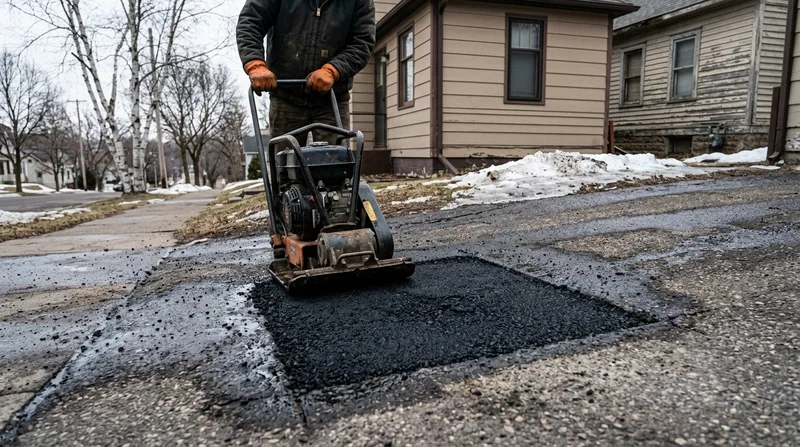




Pothole Repair & Asphalt Patching in Duluth is the first call when spring thaw opens cracks and the freeze-thaw cycle tears holes in your driveway. Duluth's climate is punishing: frost penetrates six feet deep, ice heaves slabs, and the moment temperatures swing in March and April, water enters the subsurface and explodes outward. A small crack becomes a pothole overnight. A pothole left unpatched becomes a failed section that spreads under traffic and weather. We cut the hole square, tack-coat the sides, and fill it with compacted hot mix asphalt, or we use infrared patching to recycle the surface in place for a seamless repair with no waiting. The goal is simple: stop one hole from becoming a section replacement and keep your driveway usable for years longer.
Why Spring Potholes Dominate Duluth Driveways
Duluth sits on thin rocky soil over gabbro and basalt ledge with pockets of sticky red lake clay. That geology, combined with more than 80 inches of lake-effect snow and a frost line that reaches six feet, creates the perfect conditions for pothole formation. When snow melts and rain percolates down, water fills the tiny voids in the asphalt and subbase. The first hard freeze expands that water, and the expansion pushes upward on the pavement. Spring thaw collapses the weakened spot, and traffic punches through. The Central Hillside and East Hillside neighborhoods with their 1890s Victorians and steep driveways are especially vulnerable because gravity pulls water downslope toward the street, and the short steep pitches concentrate runoff. The West End worker houses and post-war capes with their ribbon driveways and gravel pads take it too. Even the newer subdivision stock in Duluth Heights and Hermantown, where driveways are wider and flatter, cannot escape the freeze-thaw cycle.
- Water enters hairline cracks in the asphalt and freezes, expanding and lifting the surface.
- Thaw collapses the weakened base, leaving a depression that fills with water and debris.
- Traffic hammers the weakened spot, and a small crack becomes a pothole in days.
- Untreated potholes spread under the weight of vehicles and the next freeze-thaw cycle.
- Early spring patching stops the damage before it spreads to the surrounding asphalt.
This is why we book quick assessments the moment the season opens in May. One pothole caught early is a $500 repair. One pothole ignored becomes a $3,000 resurfacing.
Key info: Duluth's freeze-thaw cycle is relentless. The Minnesota Department of Transportation tracks pothole reports by region, and the Arrowhead sees the highest density in spring. If you see a pothole forming, call within 48 hours. The difference between a $450 patch and a $2,000+ section replacement is timing.
How We Repair Potholes and Patch Asphalt in Duluth
We use two methods depending on the hole size, the surrounding asphalt condition, and how long the repair needs to last. The first is the traditional cut-and-fill: we cut the pothole into a clean square or rectangle, tack-coat the sides and bottom, and compact hot mix asphalt in layers until the patch is flush and solid. The second is infrared patching, which heats the damaged asphalt and the edges of the surrounding pavement, mills it in place, adds new asphalt, and compacts it seamlessly. Infrared leaves no cold joint and bonds to the existing surface at the molecular level, which means no seams for water to enter and no waiting for the patch to cure before you drive on it. Both methods work. We choose based on the hole, the season, and your timeline.
- We assess the pothole and the surrounding asphalt to determine if the damage is isolated or part of a larger failure pattern.
- For traditional patching, we cut the hole square and remove all loose material, dirt, and water.
- We tack-coat the exposed asphalt and base to bond the new material.
- We place compacted hot mix in lifts, rolling each layer until the patch is level and solid.
- For infrared patching, we heat the damaged area and surrounding asphalt, mill the surface, add new hot mix, and compact seamlessly.
- We finish the patch flush with the surrounding pavement so water drains properly and traffic flows smoothly.
The whole process takes one to two hours for a typical pothole. You can drive on it immediately after infrared work. Traditional patches should cure for 24 hours before heavy use, though light traffic is fine.
Real example: A Duluth Heights driveway had two potholes near the garage apron after the 2024 spring thaw. We patched both with infrared in one visit. The homeowner drove on it the same afternoon. Six months later, no cracking, no settling. That is what a proper patch looks like.
If you are seeing multiple potholes across your driveway or alligator cracking over more than 30 percent of the surface, patching is not the answer. That is a sign the base is failing or the asphalt is at the end of its life. We will tell you straight: that driveway needs resurfacing or replacement, not patches. Throwing $1,500 at individual patches on a driveway that is 60 percent failed is money wasted.
Pothole Repair Methods and Materials
| Approach | Description | Best for |
|---|---|---|
| Traditional Cut and Fill | Cut the hole square, remove debris and water, tack-coat, and fill with compacted hot mix asphalt in layers. | Single isolated potholes, budget-conscious repairs, standard spring and summer season. |
| Infrared Patching | Heat the damaged asphalt and surrounding surface, mill in place, add new hot mix, and compact seamlessly with no cold joint. | Larger holes, high-traffic areas, seamless finish required, drive-on-immediately timeline. |
| Full-Depth Patching | Remove asphalt and base material completely, inspect the subgrade, repair or compact the base, and install new asphalt from subgrade up. | Deep potholes that have damaged the base, holes caused by subgrade erosion or water damage, areas with repeated pothole formation. |
| Temporary Cold Patch (Emergency Only) | Cold-mix asphalt applied without heating, used only for emergency road closure prevention or temporary hold-over until hot mix season. | Winter emergency repairs, temporary fixes when hot mix is unavailable, holding a repair until spring permanent patching. |
Pothole Repair & Asphalt Patching Cost in Duluth: What to Expect
A single pothole patch starts at around $450 to $650 for a typical 2-foot-by-2-foot hole filled and finished. That price covers the labor, materials, equipment, and compaction. If the pothole is deeper than expected and requires full-depth removal and base repair, the cost moves up to $800 to $1,200. If you have multiple potholes on the same driveway, we charge per hole, and the price per hole typically stays in the $450 to $700 range because we are already mobilized and can work efficiently. Infrared patching costs more than traditional cut-and-fill, typically 20 to 30 percent higher, because the equipment is specialized and the labor is skilled. But the seamless result and immediate drive-on time often justify the premium, especially on high-traffic driveways or in Proctor, Hermantown, or Cloquet where commercial or multi-car properties need zero downtime.
The factors that move the price up are straightforward: the size and depth of the hole, the condition of the surrounding asphalt and base, whether water damage or erosion has compromised the subgrade, and the access for equipment. A pothole on a flat driveway with solid base is cheaper to repair than a pothole on a steep hillside driveway in the Central Hillside where we need to manage runoff and ensure the patch does not slide. We provide a written estimate on site after we measure and assess the damage. That estimate includes the repair method, the material tonnage, the labor, and the timeline.
Get two or three estimates from local contractors. Make sure each estimate includes the repair method, the tonnage of asphalt, the depth of the patch, and the cure time. A lowball estimate that does not specify these details is a red flag. We will give you all of it, and we will explain why we chose the method we chose. See our full pricing overview for context on other services, and call us for a free estimate.
What to Look for When Hiring a Pothole Repair Contractor Near Me in Duluth
The asphalt paving trade has a long history of itinerant crews showing up at your door with a story about leftover material from a nearby job and a price that sounds too good. Those crews are gone by the time the patch fails. We are local. We have a Duluth address, local plates, and we have been in business since 2012. That matters because we have a reputation to protect and we will be here next spring when you need follow-up work. When you call a contractor, ask these questions: Where are you located? Can you provide references from Duluth, Hermantown, or Proctor? What is your repair method and why? Does your estimate include asphalt tonnage and patch depth? Are you fully insured? Do you have a written contract? And critically: will you be the crew that shows up, or will you subcontract the work to someone else?
- Verify the contractor is fully insured and ask to see a certificate of insurance covering asphalt paving work.
- Ask for three references from homeowners or properties in Duluth or the surrounding area where they have done pothole repair or patching.
- Get a written estimate that includes the repair method, asphalt tonnage, patch depth, and timeline.
- Check that the contractor is local and has been in business long enough to have a track record in the community.
- Understand that Minnesota does not require a state contractor license for single-skill asphalt paving work, but your city may require a permit for work on the driveway apron or in the public right-of-way, so ask the contractor how they handle local permits.
- If your property is part of an HOA, check the architectural guidelines to ensure the patching method and material comply with community standards.
The strongest trust signal in this trade is being verifiably local. We are. Contact us for a free estimate and we will walk you through the repair, answer your questions, and give you a firm price before we start work.
Pothole Repair & Asphalt Patching in Duluth: Pricing Guide
| Service | Price | Details |
|---|---|---|
| Single pothole patch (traditional cut and fill) | Starting at $450 | Typical 2x2 foot hole, includes labor, material, equipment, and compaction to flush finish |
| Full-depth pothole repair | Starting at $800 | Removal of asphalt and base, subgrade inspection and repair, new asphalt from base up, necessary when base is damaged |
| Infrared patching (seamless, drive-on immediate) | Starting at $600 | Heat, mill, and recompact in place for molecular bond, no cold joint, 20-30 percent premium over traditional for zero-downtime repair |
| Multiple potholes on same driveway | Starting at $450 per hole | Per-hole pricing holds when mobilized on one property, efficiency discount applies to three or more patches |
| Complex job or emergency repair | On estimate | Deep erosion, subgrade failure, winter emergency, or uncertain scope requires on-site assessment before pricing |
| Free estimate and travel | No charge | Included in Duluth and surrounding service areas, response within 24 hours at (218) 514-6861 |
Indicative pricing, the exact cost depends on square footage, finish, and site access. Free personalized estimate within 24h at (218) 514-6861.


