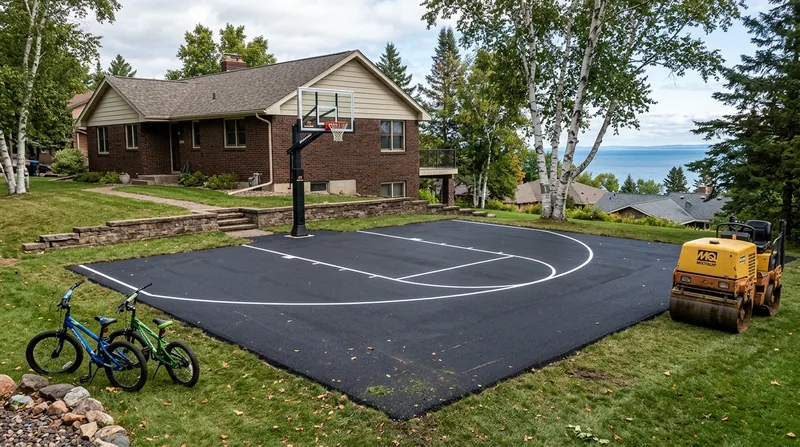




Backyard basketball courts, tennis bases, pickleball surfaces, and walking paths in Duluth demand more than standard asphalt. Sports court and path paving in Duluth requires dead-flat installation, tight surface tolerances, and a structural base built to withstand the Northland's brutal frost cycles and heavy lake-effect snow loads. The hillside terrain of the Central Hillside and East End, the flatter subdivisions of Duluth Heights and Hermantown, and the long private roads of the North Shore toward Two Harbors all present different challenges: steep drainage, shallow bedrock, and freeze-thaw heave that lifts ordinary driveways six inches in spring. We build court and path asphalt on a deep base with proper grading and proof rolling so your surface stays true through the freeze, and the finished court accepts acrylic color systems and line markings without cracking or settling.
Why Sports Court and Path Paving Matters in Duluth's Climate
Duluth's frost line runs six feet deep, and the ground beneath a court or path is thin rocky soil over gabbro and basalt ledge with pockets of sticky red lake clay. Frost heave does not care whether the surface is a driveway or a basketball court. A poorly built court base will crack, settle unevenly, and trap water in spring thaw, destroying the acrylic finish and making the surface unsafe for play. The short paving season, roughly May through October, means every job must be planned and executed right the first time. We design court and path bases with deep compacted stone, proper subsurface drainage, and finished surfaces that shed water away from the playing area so the court stays playable and safe year after year.
- We grade the subbase to shed water away from the court footprint, preventing pooling and ice formation in winter.
- We compact and proof-roll the base stone in lifts to eliminate settlement and soft spots under the finished asphalt.
- We install the asphalt in a single season so the court is ready for acrylic application and line work before fall.
- We specify thickness and tonnage on every estimate so you know exactly what you are paying for and what will be delivered.
A court built right will hold its surface for 15 to 20 years with basic maintenance. A court built on a weak or poorly drained base will fail in three to five years, and you will have paid twice.
Key info: Minnesota frost heave is not a minor issue. A basketball court in Hermantown or Proctor that is not built on a proper base will shift and crack within two or three seasons. The cost to rebuild a failed court is triple the cost to build it right the first time. We see this every spring.
For more information on how base preparation affects all asphalt surfaces, see our Gravel Driveway Installation & Grading page, which covers the same subsurface principles.
How We Build a Sports Court and Path Paving System in Duluth
Court and path paving is a four-phase process. We start with a site walk to understand drainage, slope, and soil conditions. We then excavate and prepare the subgrade, install a deep compacted stone base, and finish with a tight asphalt surface course. Every step is measured and documented on the estimate so you know what will be delivered and when.
- We visit the site, measure the court footprint, and identify drainage patterns and soil type so we can design a base that will not settle or heave.
- We excavate to proper depth, remove soft or unstable soil, and compact the subgrade in lifts with mechanical equipment.
- We install compacted stone base in measured lifts, proof-roll the surface with a heavy vibratory roller, and verify bearing and flatness before asphalt placement.
- We place a tight-tolerance asphalt surface course in a single lift, finish to a dead-flat plane within one-quarter inch per ten feet, and cure before acrylic application.
The finished court is ready for line marking and acrylic color coating within one to two weeks of completion. New asphalt must cure for six to twelve months before a seal coat is applied, so we do not recommend sealing a new court until the following year.
Local example: A half-court basketball installation in Duluth Heights required 2,000 square feet of finished asphalt on a sloped lot with poor drainage. We excavated eighteen inches, installed eight inches of compacted stone base with a subsurface drain, and finished with three inches of tight-tolerance asphalt. Total base cost was roughly $12,500 including excavation and stone. The homeowner then applied acrylic paint and line markings himself. The court has held true for four seasons.
Related: See our Asphalt Driveway Paving & Installation page for the same base-building principles applied to residential driveways.
Court and Path Paving Methods and Materials
| Method | Description | Best for |
|---|---|---|
| Full-depth court installation | Excavate to subgrade, install compacted stone base, finish with tight-tolerance asphalt surface course. | New courts on marginal or sloped terrain where base stability is critical to long-term performance. |
| Asphalt overlay on existing base | Mill or scarify existing surface, install new asphalt wearing course over stable base stone. | Courts where base is sound but surface is cracked or worn, and where flatness and drainage are already adequate. |
| Walking path and cart trail paving | Compact subgrade, install four to six inches of stone base, finish with two-inch asphalt wearing course. | Golf cart trails, garden paths, and access lanes through properties where light traffic and seasonal use are the design load. |
| Milled and repaved court surface | Remove top one to two inches of asphalt, compact subbase, place new tight-tolerance surface course. | Existing courts with surface cracking or uneven wear where the base stone is stable and drainage is functioning. |
Sports Court and Path Paving Cost in Duluth: What to Expect
A full-depth basketball or tennis court in the Duluth area starts at $8,500 to $12,000 for a half-court (roughly 2,000 square feet) on level ground with good drainage and accessible subgrade. Costs move higher with slope, poor soil, deep excavation, or subsurface drainage work. A full court (4,000 square feet) typically runs $15,000 to $22,000 depending on site conditions. Walking paths and golf cart trails are less expensive per square foot because they carry lighter design loads and require thinner base and wearing course.
The single largest cost driver is site preparation and base work. A sloped lot in the East End or Central Hillside that requires excavation, soil removal, and deep stone base will cost more than a flat lot in Hermantown or Proctor. Poor drainage, shallow bedrock, or unstable clay soil also add to the excavation and stone tonnage. Every estimate includes the exact stone tonnage and asphalt tonnage so you know what is being delivered.
We recommend getting two or three estimates so you can compare base specifications, asphalt thickness, and warranty language. A suspiciously low estimate often reflects a thinner base, less stone, or poor drainage planning that will show up as cracking and settling within two or three years. The cheapest court is not the best value.
For detailed pricing on all services, including court and path work, visit our pricing page.
Sports Court and Path Paving Near Me: What Duluth Homeowners Should Know Before Hiring
Court and path paving is a specialized service, and not every asphalt contractor has the equipment or experience to finish a surface dead-flat and to tolerance. Before you hire, ask the contractor for references from court or path projects completed in the last three to five years. Ask to see the finished surface and ask the property owner about performance through at least one winter frost cycle.
Verify that the contractor carries full general liability insurance and can provide a certificate of insurance naming you as an additional insured. Ask whether the estimate includes subsurface drainage, compacted stone tonnage, asphalt tonnage, and finished surface tolerance. If it does not, ask why. Ask whether the contractor will proof-roll the base and document the results. A contractor who cannot or will not answer these questions is not a good fit for a court or path project.
Check whether your local municipality requires a permit for court or path work. In Duluth, driveway aprons and certain site work may require a permit from the city building department. If your court is in a homeowners association, check the architectural standards to confirm that asphalt is an approved material and that the color and finish meet HOA requirements. Minnesota 811 utility locates are required by law before any excavation, and we handle that as part of the project.
Call us at (218) 514-6861 for a free estimate. We will visit the site, measure the footprint, assess soil and drainage, and provide a written estimate with tonnage and thickness specifications within 24 hours. There is no obligation to book, and we are happy to answer questions about the process.
Sports Court & Path Paving in Duluth: Pricing Guide
| Service | Price | Details |
|---|---|---|
| Half-court basketball or tennis (2,000 sq ft) | Starting at $8,500 | Includes site prep, compacted stone base, tight-tolerance asphalt surface, and one year workmanship warranty |
| Full court (4,000 sq ft) or larger installation | Starting at $15,000 | Includes excavation, deep stone base, asphalt wearing course, and subsurface drainage design for frost and runoff |
| Walking path or golf cart trail (per 1,000 sq ft) | Starting at $3,500 | Lighter design load, thinner base and surface, suitable for seasonal or light-traffic access through property |
| Slope and drainage work | On estimate | Sloped lots, poor soil, shallow bedrock, or subsurface drains require site visit to assess excavation and stone tonnage |
| Travel and site estimate | Free | Included in Duluth and surrounding areas, response within 24 hours at (218) 514-6861, no obligation to book |
Indicative pricing, the exact cost depends on square footage, finish, and site access. Free personalized estimate within 24h at (218) 514-6861.


